1. When collecting e-cigarette payments in Australia, why can’t we just compare the handling fees?
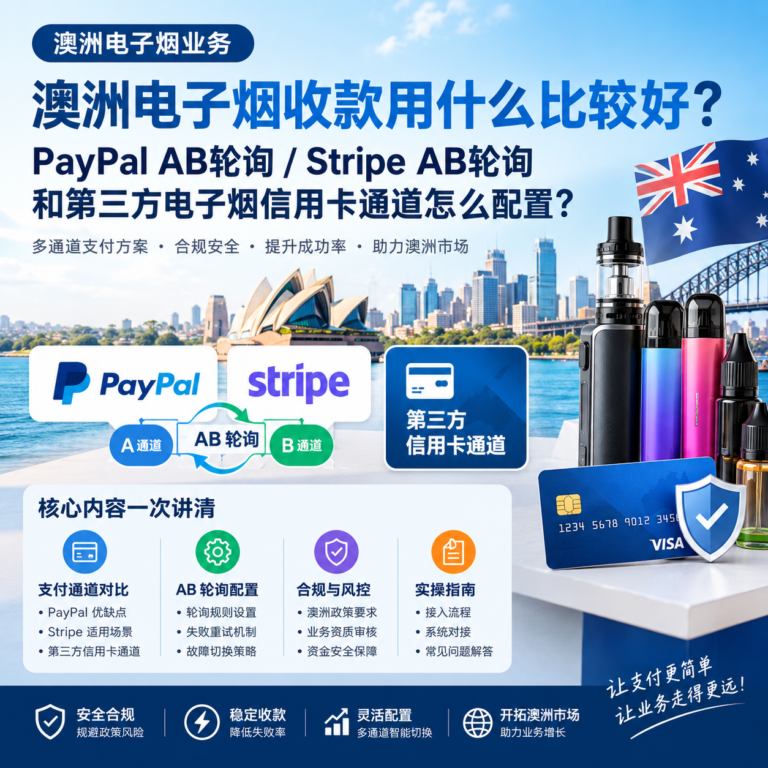
If you are building an app for the Australian markete-cigarette website, you may have discovered that the payment collection solution is far more complicated than ordinary cross-border e-commerce. PayPal, Stripe and third-party credit card acquirers can all provide different forms of payment services, but this does not mean that they all accept e-cigarette business, nor does it mean that if one platform can collect payments normally, other platforms can definitely access it.
What really needs to be considered is not just the transaction rate, but also business access, whether the product is legal, merchant entities and sales areas, settlement cycles, chargeback processing, fund freezing risks, and how to coordinate among multiple payment channels.
Especially when a website plans to use PayPal, credit cards and other payment services at the same time, two issues must be distinguished:Whether payment channels are allowed for your business to use, and whether technical systems are able to properly manage these channels. The former determines whether the service can be accessed, and the latter determines whether it can run stably after access.
For the Australian market, local e-cigarette regulatory requirements need to be verified first. The Australian government stipulates that in principle, e-cigarettes and related products can only be supplied in pharmacies that meet the requirements for treatment purposes such as quitting smoking or managing nicotine dependence. Ordinary tobacco retail stores, e-cigarette shops and convenience stores cannot obtain legal sales qualifications just because they have a payment website. Specific products, supply entities, imports and supply chain arrangements also need to meet corresponding requirements. For details, please see the Australian Government’sE-cigarette regulations explainedand TGA’sRetailer Guidelines。
Therefore, this article discusses how businesses that operate legally, comply with applicable regulatory requirements, and have obtained approval from the corresponding payment institution evaluate and manage payment collection solutions, rather than solving business problems that do not meet the access conditions by changing channels.
2. First confirm the compliance boundaries of Australia’s e-cigarette business
Before applying for a payment channel, it is recommended to verify the requirements at three levels.
1. Are sales allowed by local Australian regulations?
First, confirm the specific category, use, supplier and target sales method of the product.
E-cigarette supervision does not just look at whether the product contains nicotine. Australia’s relevant regulatory framework also covers nicotine-free e-cigarette products and imposes restrictions on supply, commercial holding, import, manufacturing and advertising.
If you are dealing in e-cigarettes for therapeutic purposes, you need to further confirm whether the product meets the corresponding standards, whether it is within the scope of products allowed to be supplied, and whether the pharmacy or related supply entities meet the requirements. There may also be regulations in different states and territories that require additional verification.
The most common misunderstanding here is to directly regard products that are allowed to be sold in other countries as products that can be sold to consumers in Australia. The rules of the target market must be verified individually, without reference only to the location of the registered company or the location of the warehouse.
2. Whether the payment institution accepts the business
Just because a product complies with local law does not mean that all payment institutions must accept it.
Payment institutions need to consider their own policies, acquiring bank requirements, card organization rules and risk control requirements at the same time. For categories such as e-cigarettes, tobacco, and regulated goods, additional review may be required, and related services may not be provided.
For example, PayPal Australia's "Acceptable Use Policy" includes e-cigarettes and some tobacco products in categories that require prior approval; Stripe includes e-cigarettes, cigars, and e-liquids in its restricted business scope, which requires further due diligence and does not guarantee approval. The relevant rules shall be based on the official terms applicable at the time of application.
This means that just because an account has been successfully created or a test transaction has been successful, it does not mean that the account is allowed to handle e-cigarette transactions for a long time. The application subject, website, products and actual transactions must be consistent with the approved scope.
3. Only after the business is approved will the payment system design begin.
If the business does not comply with local regulations, or the payment institution clearly does not accept the business, then adding payment channels will not solve the fundamental problem.
If the business meets the requirements and has been approved for the corresponding service, then it is worthwhile to compare payment methods, design transaction routing, configure order status management and financial reconciliation.
This order is important: determine the available services first, and then design how to use the services, rather than connecting multiple interfaces first and then trying to get them to accept transactions that have not yet been approved.
3. What is the difference between PayPal, Stripe and third-party credit card channels?
These three types of programs are not entirely at the same level. PayPal is a payment service familiar to consumers; Stripe provides payment processing and related development tools; third-party credit card channels may involve different acquirers, payment service providers and merchant account arrangements.
The comparison should look at the actual contract and scope of services, not just the brand name.
| Compare items | PayPal | Stripe | Third-party credit card channels |
|---|---|---|---|
| main form | PayPal wallet and related payment services | Online payment processing and development interface | Depends on specific acquirer and service provider |
| E-cigarette business access | Requires verification of applicable policies and prior approval requirements | Restricted business, need to verify acceptance and approval | It is necessary to confirm whether the product, region and subject are approved on a case-by-case basis |
| Credit card payment | Depends on specific product and account configuration | Depends on region, product and account qualifications | Usually the core is credit card acquiring, but the specific capabilities vary. |
| Access method | Official checkout solution or corresponding interface | API, official components and related integrations | Possibly accessed via API, hosted payment page or official plugin |
| settlement arrangements | Subject to account and applicable terms | Subject to account and applicable terms | Subject to contract, acquirer and risk policy |
| cost | Calculated based on actual account rate and transaction type | Calculated based on actual account rate and transaction type | May involve transaction fees, monthly fees, reserves, etc. |
| main check points | Business approval, account restrictions, dispute handling | Business access, service scope, risk review | Acquiring entity, merchant category, settlement terms and fund security |
This table is not a substitute for specific quotes or merchant review results. Different countries, merchant entities, products and payment services may apply different terms, so it is not appropriate to use a fixed rate to represent the entireAustralian e-cigarette paymentmarket.
1. PayPal: Focus on confirming business approval and account application scope
The advantage of PayPal is that some consumers are familiar with its payment methods, and merchants can choose appropriate integrations based on account qualifications.
However, for e-cigarette business, it is first necessary to verify whether prior approval has been obtained that is applicable to the actual business model. PayPal Australia’s policy includes e-cigarettes and some non-cigarette tobacco products as categories requiring pre-approval. Whether a specific application is approved depends on PayPal's judgment based on the merchant's information and actual business.
It is recommended to prepare before applying:
Complete and true company and beneficial owner information;
Description of website, products and actual sales model;
Applicable operating licenses, product compliance or supply chain certifications;
Refund, shipping, customer support and dispute resolution policies;
Information such as target country, expected transaction size and average order value.
Don't take "being able to create an account", "the interface can be called" or "having received a payment" as evidence that the business has been officially approved.
2. Stripe: Focus on verifying restricted business policies
Stripe provides relatively complete development tools, payment interfaces and transaction event management capabilities, so it is often used to customize e-commerce checkout processes.
However, technical capabilities do not equal industry access. Stripe's current Restricted Business Policy explicitly lists e-cigarettes, e-liquids and related tobacco products as categories requiring additional due diligence and explains that even if approval is provided, the scope of the approval may be service-specific and may be adjusted or withdrawn in accordance with the applicable terms.
Therefore, we cannot generally say that "Stripe can definitely be used to collect e-cigarettes in Australia", nor can we infer that just because websites in other industries use Stripe, the e-cigarette business can also be copied.
If you are considering Stripe, you should confirm with Stripe whether the actual merchant entity, product type, target market, checkout method, and specific services are approved before officially joining, and keep a written response or applicable approval record.
3. Third-party credit card channel: focus on the acquiring relationship and contract
Third-party credit card payment services vary widely. Some service providers directly provide acquiring services, some are technology platforms or payment service providers, and some simply refer merchants to other institutions.
So look beyond the rates promised by the salesperson and the words "high-risk industry support." At least the following items need to be confirmed:
Who is the real acquiring or settlement entity? Be clear about who signed the contract, the institution that processed the transaction, and into which account the funds actually went.
Do you explicitly accept the business? Let the service provider confirm in writing the product category, operating area, merchant entity and transaction method.
How are rates structured? Verify transaction fees, monthly fees, chargeback fees, chargeback fees, cross-border fees and possible reserves.
When will funds be settled? Confirm the settlement currency, cycle, minimum settlement amount and delayed settlement conditions.
What to do if a dispute occurs? Verify chargeback notices, evidence submission timelines, refund responsibilities and the handling of funds after contract termination.
To what extent is the technical support provided? Clarify whether API, webhooks, refunds, transaction queries, reconciliation files, and failure support are included in the service.
If the service provider is unwilling to clearly disclose the subject of the contract, fee structure or actual business restrictions, it is not appropriate to decide to cooperate based on low rates alone.
4. What is AB payment polling? How is it different from ordinary payment methods?
In the context of cross-border e-commerce,AB payment pollingIt usually means that the merchant system accesses multiple payment channels that have been approved for use, and the payment routing logic selects the corresponding channel for eligible transactions based on predefined rules.
A and B here are just the names of the two channels. For example, A could represent one approved payment service and B represents another independently approved credit card acquiring channel. Which services are actually used depends on business qualifications, regional support and contractual agreements.
AB payment polling is not a payment method that consumers must understand, but a transaction routing mechanism in the merchant's backend.
1. Polling does not mean simply sending A and B
The simplest polling might assign transactions sequentially, such as first to A, next to B, and then continue in the loop.
But in actual payment systems, mechanically alternating transactions may not be a reasonable solution. Different channels may support different currencies, card types, regions and transaction types, and may also have different availability and transaction restrictions.
What's more, a failed payment doesn't always mean there was no charge. Sometimes the request times out, but the payment service provider has received the request and even completed the authorization. If the system immediately resends the same order to another channel, it may cause repeated deductions.
Therefore, routing design in a production environment usually needs to consider transaction qualifications, channel status, amount limits, currency support, idempotence, and payment result confirmation, not just A/B alternation.
2. The difference between AB polling, payment failure retry and failover
These three concepts are often conflated and have different actual purposes.
| mechanism | main purpose | Typical trigger conditions | Main risks |
|---|---|---|---|
| AB polling | Allocate eligible transactions according to predetermined rules | New transactions enter the routing system | Unreasonable rule design leads to imbalanced transaction distribution |
| Payment retry | Reprocess requests that are explicitly safe to retry | Temporary network failure or qualified failure | Repeated deductions and repeated submissions |
| failover | When an approved channel is unavailable, use another eligible channel | Health check failure or service interruption | Re-initiating payment without confirming the original transaction result |
| Consumers actively switch ways | Allow consumers to choose another available payment method | The original method fails or consumers actively choose | Order status is out of sync and repeated payments are made |
For example, when consumers use channel A to pay, the page does not receive clear results. If the system only sees "request timeout" and directly asks channel B to deduct money again, it may happen that A actually succeeds and B also succeeds.
The correct way to deal with it is not to switch blindly, but to check the original transaction status first, confirm whether it has been authorized or deducted, and then decide on the next step. For transactions whose results cannot be determined, they should enter the pending confirmation state instead of failing by default.
3. What can AB polling solve and what cannot it solve?
As long as the channels are approved and the interfaces are correctly integrated, a reasonable multi-channel architecture can help merchants unify order management, monitor channel health, and manage payment methods in compliance with contract and transaction conditions.
But AB polling itself cannot:
Turn unapproved business into business acceptable to payment institutions;
Guarantee that every transaction will be successful;
Automatically reduce any risk of chargebacks or fraud;
Guarantee that funds will not be delayed in settlement or review;
Replace the transaction review and risk control requirements of payment service providers.
Therefore, when evaluating the value of AB polling, you cannot just look at how many channels are connected, but whether it improves system availability, order management, and financial transparency, while maintaining compliance with the usage scope of each channel.
5. How should the AB multi-payment channel system be designed?
For businesses that have obtained relevant approvals, it is recommended to split the payment system into the order layer, routing layer, channel adaptation layer and reconciliation layer. In this way, even if the service provider is changed in the future, there is no need to rewrite all the business logic.
1. Order level: Create a unique order first
After the consumer clicks to pay, the system first creates an internal order and generates a unique order number.
The order should be saved at least:
Internal order number;
Merchant entity and business identification;
Order amount and currency;
Current order status;
Selected payment method;
Payment service provider transaction number;
Creation time, update time and necessary audit records.
Amounts should be saved using the smallest monetary unit or a reliable fixed-point scheme to avoid decimal precision issues caused by floating-point calculations.
For example, an order of AUD 129.95 should be saved with the exact amount specified by the system rather than relying on unstable floating point calculations. The final amount sent to the payment service provider must be consistent with the order amount, and the amount of the product cannot be changed due to routing switching.
2. Routing layer: select channels only within approved ranges
The routing layer is responsible for determining which accessed channels are qualified to process this transaction.
Judgment conditions may include:
Whether the merchant is approved for the service;
Whether the channel supports the target country and currency;
Whether the transaction type is within the scope of the contract;
Whether the channel is in normal operation;
Whether the amount, card type and other restrictions are met;
Whether there is an original payment request that is not completed or has an unknown outcome.
Only channels that meet all applicable criteria should be considered candidates.
If there is no eligible channel, the system should provide consumers with clear and compliant processing results, such as prompting that payment is temporarily unavailable, keeping the order pending, or allowing consumers to choose other approved payment methods instead of sending the transaction to an inapplicable channel.
3. Channel adaptation layer: unify the interfaces of different service providers
Different payment providers may use different fields, response codes, and payment statuses. In order to avoid business code being tightly bound to a single service provider, a unified data structure can be established internally.
For example, internal transaction records can contain:
| Field | Purpose |
|---|---|
order_id | Merchant internal order number |
provider | The service provider that actually processes the transaction |
provider_transaction_id | Transaction number returned by the service provider |
amount | Transaction amount |
currency | Transaction currency |
payment_status | Unified internal payment status |
idempotency_key | Unique request identifier to prevent duplicate submissions |
created_at | creation time |
updated_at | Last updated |
This is just an example to illustrate the data model and is not a fixed API format for any one payment service provider. For specific fields, request methods and idempotence support, please refer to the corresponding interface document.
4. Payment status layer: Do not regard page jump as payment success
When the consumer returns to the website success page, it does not mean that the service provider has confirmed that the payment was successful. The payment result should be confirmed based on the service provider's formal response, transaction query interface, and verified Webhook and other mechanisms.
Internal states can at least be distinguished:
created: The order has been created, but payment has not been initiated yet;pending: Payment is being processed and the result has not yet been determined;succeeded: The payment service provider has confirmed successfully;failed: The transaction has clearly failed;cancelled: Transaction canceled;refunded: Refunded;partially_refunded: Partial refund;disputed: The transaction enters dispute processing.
These are sample states for internal systems and are not meant to be used by all service providers with the same original state names. During integration, the status of each company must be mapped to the internal model, and the original response must be retained for troubleshooting.
What needs special attention is thatpending should not automatically be considered failed. When the original transaction result is unknown, you should first query or wait for reliable status notification to avoid repeated deductions for the same order.
5. Webhooks and idempotence: a key line of defense for multi-channel systems
Webhook is used to receive transaction events sent by payment service providers, but any received request cannot be directly regarded as a trusted payment notification.
The system should verify the authenticity of the signature or message according to the service provider's interface requirements, check the correspondence between events and orders, and confirm whether the amount, currency, and transaction number match.
At the same time, order status updates should be idempotent: even if the same successful notification arrives repeatedly, it cannot cause the order to be shipped repeatedly, repeatedly entered into the account, or repeatedly performed other business operations.
If the payment service provider supports idempotent request flags, it should be used correctly according to its documentation. Even if idempotence is supported, the scope and validity period of the mechanism must be clarified, and it cannot be assumed that it can cover repeated requests between all service providers.
6. Reconciliation layer: allows orders, payments and bank accounts to correspond
Successful payment does not mean that all financial issues have been resolved. The service provider may settle in batches, deduct processing fees, or generate separate fund records for items such as refunds, chargebacks, and reserves.
Therefore, it is recommended to keep at least three categories of records:
Order record: What did the consumer buy, how much was paid, and what is the current status of the order.
Payment transaction history: Which service provider processed the transaction, whether the transaction was successful, and whether a refund or chargeback occurred.
settlement record: When the service provider settled, how much was actually settled, what fees were deducted, and whether the funds entered the corresponding bank account.
These three types of records cannot simply be combined into one "order success table". Only by establishing a clear correspondence can the cause be found when billing discrepancies occur.
6. A complete transaction case: from order placement to reconciliation
A purely example set of data is used below to illustrate how a multi-channel system should record transactions. Figures do not represent actual average rates or real merchant cases in the Australian e-cigarette industry.
Let's say an approved merchant receives an order for AUD 129.95. The system accesses two approved payment channels A and B.
Scenario 1: Channel A clearly pays successfully
The system creates an order
ORD-10001, the amount is AUD 129.95.The routing layer selects channel A based on service qualifications and channel status.
A returns the transaction number and subsequently confirms success through a reliable transaction result notification or query interface.
The system checks the order amount, currency and transaction number, and updates the internal order status.
The order enters the subsequent fulfillment process.
The financial system records the transaction and waits for verification of the service provider's settlement documents and bank entry information.
In this case, the system should not initiate a second deduction to B because the original transaction was successful.
Scenario 2: Channel A request times out
The system creates the order and sends a payment request to A.
The network request timed out and the system did not receive a clear result.
Internal order entry
pending, instead of directly marking it as failed.The system confirms the transaction status through the query method allowed by the service provider, or waits for a trusted asynchronous notification.
If the original transaction is confirmed to be successful, continue to update the order status.
If the transaction is confirmed to have failed and the relevant rules are met, the system will allow the consumer to repay or choose another channel according to the approved strategy.
If the result is still unknown, leave it in the pending confirmation state to avoid immediately initiating another transaction for the same order that may cause repeated deductions.
This scene explains:Timeout means that the communication result is uncertain and does not mean that the payment has failed.
Scenario 3: Consumer needs a refund
Assume that the order has been successfully paid, but a subsequent refund is required due to legitimate and reasonable business reasons.
The system should use the service provider and transaction number corresponding to the original transaction to initiate a refund, and record the refund amount, refund time, status returned by the service provider, and reason for the refund.
If the original transaction was processed by A, A's refund cannot be submitted directly to B just because B is currently functioning normally. B does not have a record of the original transaction and cannot naturally replace A to complete the refund of the original transaction.
Refund status should also be managed independently: submitting a refund request does not equate to a refund being completed. The system needs to continue to confirm the final result and reflect the refund and related charges in the financial reconciliation.
7. How should the fees for Australia’s e-cigarette collection program be calculated?
Many merchants only compare transaction rates when choosing payment channels, but what really affects profits is the total payment cost, not a single percentage in the quotation table.
The following models are available:
Total payment cost = transaction processing fee + fixed monthly fee + chargeback and chargeback fees + currency conversion fees + other contract fees + payment system maintenance costs
If the servicer is also involved in reserves or settlement delays, it is recommended to additionally evaluate the impact of the tied up funds on cash flow. Reserves are not necessarily final expenses but may affect short-term available funds.
1. Compare costs using sample data
Assume that the effective transaction amount in a month is AUD 100,000 and the number of transactions is 1,000. The following figures are only calculation demonstrations and do not represent actual quotes from any service provider.
| Project | Plan A | Plan B |
|---|---|---|
| Assumed transaction fee | 3.0% | 2.6% |
| Assume that each fixed fee | AUD 0.30 | AUD 0.35 |
| Assuming monthly fee | AUD 0 | AUD 50 |
| Trading fees calculated by sample trading volume | AUD 3,000 | AUD 2,600 |
| Total fixed charges per transaction | AUD 300 | AUD 350 |
| Cost after adding monthly fee | AUD 3,300 | AUD 3,000 |
In this hypothesis, option B has lower direct costs. But if B has other fees, higher reserve requirements, or a longer settlement cycle, you can’t conclude that B is a better fit based solely on the results in the table.
The correct approach is to incorporate all applicable fees into the model, and then make judgments based on settlement conditions, refund rules, and business support capabilities.
2. Calculate the real income of multi-channel
The value of multi-channel should not only be based on the even distribution of transactions. More importantly, it improves eligible transaction processing, system availability, consumer payment experience and financial management.
For example, if the interface of a certain channel often appears in an uncertain state, adding a second channel will not necessarily immediately improve the experience. If the system does not have the ability to handle repeated transactions, Webhook verification, and order status synchronization, it may increase repeated deductions and reconciliation errors.
Therefore, when evaluating AB payment polling, it is recommended to continuously observe the following indicators:
Availability of each channel and interface error rate;
Clearly define the proportion of successful, failed and pending transactions;
Repeated requests, repeated deductions and inconsistent order status events;
Refunds and chargebacks;
Transaction processing fees and other direct costs;
Settlement differences and reconciliation completion time.
These indicators are used to judge the quality of system operation and should not be used as a means to circumvent the service provider's risk control or violate transaction conditions.
8. Checklist before accessing third-party payment channels
If you decide to evaluate a third-party credit card channel, it is recommended that you complete the following checks before investing in development costs.
Merchant access
Confirm that business entities, products and target markets comply with applicable laws.
Confirm that the service provider clearly accepts this business category.
Confirm that the approval covers actual merchant entities, products and transaction methods.
Maintain records of formal contracts, policy versions, and necessary written approvals.
Confirm the true identity and responsibilities of the service provider and its acquiring partners.
Fees and Billing
Get a full rate schedule instead of just accepting a verbal quote.
Confirm transaction fees, flat fees, chargeback fees, chargeback fees and cross-border fees.
Confirm the settlement cycle, currency, minimum settlement amount and reserve arrangement.
Confirm how unsettled funds will be handled after account termination.
Confirm that the settlement report provides sufficient transaction details for reconciliation.
Technology and Risk Management
Verify API, webhooks, refund and transaction query capabilities.
Confirm the specific meaning of payment status and asynchronous processing method.
Design order idempotence and duplicate transaction protection.
Establish transaction abnormality alerts and manual verification processes.
Verify the status flow of refunds, chargebacks and partial refunds.
Establish associations between orders, payment transactions and settlement records.
Contracts and service support
Be clear about what types of transactions the servicer can handle.
Confirm notification mechanisms in the event of an audit, trading suspension, or account restriction.
Confirm the time limit for submission of evidence of chargeback and the allocation of responsibilities.
Confirm response channels and support times for technical failures.
Confirm arrangements for contract changes, terminations and data exports.
If it involves business access, fund settlement or fund processing after termination, it is recommended to ask the relevant service provider to answer in writing before signing the contract. For high-risk or regulated businesses, verbal commitments are a poor substitute for formal contract terms.
9. Frequently asked questions about e-cigarette payment in Australia FAQ
1. Can Australian e-cigarette websites use PayPal to collect payments directly?
It cannot be generalized. PayPal Australia's acceptable use policy lists e-cigarettes and some non-cigarette tobacco products as categories that require prior approval. Merchants should verify the current policy and their specific scope of approval. They cannot assume that the business is approved just because the account can be created or the interface can be called.
In addition, payment institution approval and Australian local sales compliance are two separate issues. Even if a payment institution accepts a certain business, it does not mean that the relevant products or sales methods automatically comply with Australian law.
2. Can Australian e-cigarette business use Stripe?
Subject to Stripe's current applicable restricted business policies and the merchant's explicit approval. Stripe places e-cigarettes, e-liquids and related tobacco products in restricted business categories, which may require additional due diligence and does not guarantee that all applications will be approved.
Before formal access, you should verify with Stripe whether the actual merchant entity, product category, target market and specific services are within the approved scope.
3. What does AB payment polling mean?
AB payment polling usually refers to the merchant system allocating eligible transactions among multiple approved payment channels according to preset rules. It is a backend payment routing mechanism and is not a payment method that consumers must understand alone.
Polling can allocate new transactions according to rules, but it cannot automatically resolve all failed transactions, nor can it replace the payment service provider's business review and risk control requirements.
4. Does AB polling automatically switch to channel B after channel A fails?
Not necessarily. Polling, retry on failure, and failover are different mechanisms. Especially when channel A returns a timeout or the status is unknown, you cannot directly assume that the payment failed and then let channel B deduct money again.
The original transaction status should be confirmed in accordance with the service provider's interface rules before deciding whether to allow a safe retry or let the consumer choose another payment method.
5. Can multiple payment channels share the same order system?
A unified order management can be designed, but each payment service provider still needs to independently save the transaction number, original status, refund record and settlement information. The system also needs to handle state mapping, webhook validation, and idempotence for different interfaces.
The goal of the unified order system is to improve management efficiency rather than conflating contracts, transactions and refund responsibilities of different service providers.
6. Is the lower the third-party credit card channel rate, the better?
uncertain. In addition to transaction rates, fixed fees, monthly fees, chargeback fees, chargeback fees, cross-border fees and other contract fees should be calculated, and billing cycles, reserves and dispute handling capabilities should be evaluated.
Low rates may not necessarily be a better solution if they are accompanied by opaque acquiring relationships, vague business approval scope, or unreasonable funding terms.
7. After the payment is successful, why does it need to be reconciled?
Because the payment success record in the order system is not necessarily the same as the amount actually settled by the service provider into the bank account. Fees, chargebacks, chargebacks, reserves, and billing batches can all cause differences.
By correlating order records, payment transaction records and settlement records, merchants can locate the link where the discrepancy occurs, rather than just relying on the order status in the backend of the website to determine whether funds have been received.
8. After the payment channel is suspended, can all orders be transferred to another channel immediately?
It cannot be generalized. First, confirm the reason for the suspension of the original channel, the scope of affected transactions, and how to handle transactions that have not been completed or have unknown results. For payments that have already been initiated, the transaction status should be verified first to avoid repeated deductions.
Only when the alternative channel itself has been approved to handle the corresponding business, has the required capabilities, and meets the contract and transaction conditions, the alternative should be used according to the established process.
10. Conclusion: Confirm business qualifications first, and then design the AB multi-channel collection system
Getting paid for e-cigarettes in Australia is not simply about choosing the lowest-price option between PayPal, Stripe and third-party credit card channels. Local regulations, payment institution access, merchant contracts, fund settlement and technical implementation all determine whether a collection system is available.
For businesses that have obtained relevant approvals, PayPal, Stripe or third-party credit card services should be evaluated separately based on actual scope of application. AB payment polling should be understood as a set of transaction routing and status management mechanisms, not a tool to ensure successful payment, let alone a replacement for business access review.
System capabilities that are truly worth investing in include: clear merchant access records, reliable order status models, idempotence and duplicate transaction protection, verifiable payment result notifications, and financial reconciliation processes that can one-to-one correspondence between orders, transactions, refunds, and settlements.
Before deciding which solution to adopt, it is recommended to obtain a clear answer from the payment service provider regarding the actual business, and then compare the complete fees and contract conditions.It is a more prudent decision-making sequence to first confirm whether it can operate legally and whether it can be allowed to collect money, and then discuss how to improve system reliability through multiple channels.
Official reference material
Australian Government: Vaping laws ——Overview of Australian e-cigarette regulations.
Australian Therapeutic Goods Administration TGA: Vapes — information for retailers — Retail supply and related restrictions.
PayPal Australia:Acceptable Use Policy — Restricted goods and prior approval requirements.
Stripe:Prohibited and Restricted Businesses ——Restricted business and due diligence requirements.
Description: This article is for payment solution evaluation and technical architecture reference and does not constitute legal, tax or financial advice. Regulations, provider policies and contract terms may change, and the latest applicable requirements should be verified before implementation.