1. Why can we still see a large number of imitation brand advertisements on Facebook?
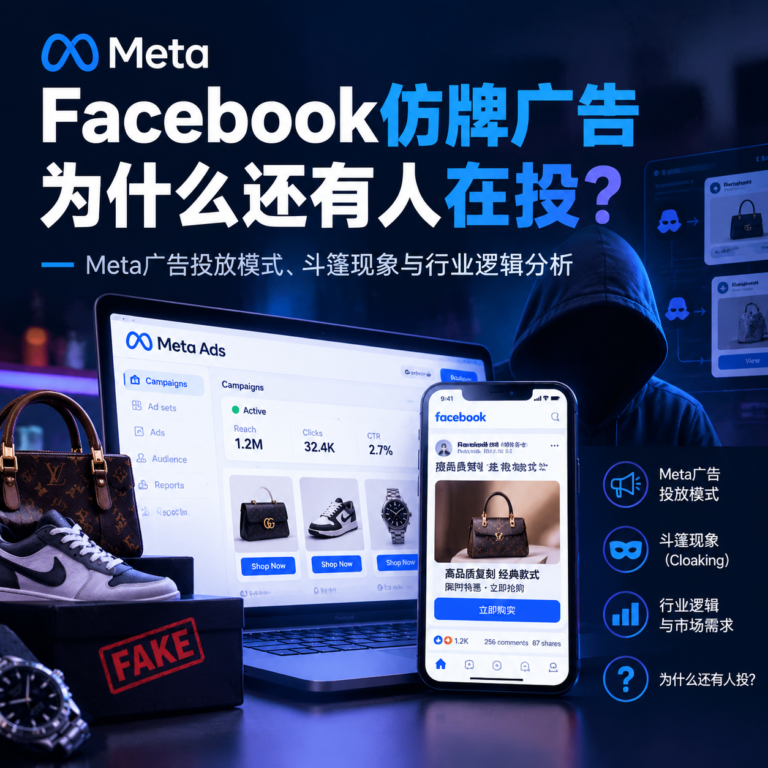
People who frequently browse social platforms such as Facebook and Instagram may notice a phenomenon: Although the platform continues to crack down on counterfeit goods and illegal advertising, you can still occasionally see promotional content for suspected counterfeit goods in the information stream. Some advertisements directly guide users to independent websites for purchase, while others communicate with customers through Messenger, WhatsApp and other channels.
This also raises a question worthy of analysis: Since imitation brand advertising involves high audit and operational risks, why do some people still choose Meta advertising channels?
To understand this phenomenon, we need to distinguish three concepts:There is demand for relevant products in the market, advertisements can be displayed, and the advertising business can continue to operate in the long term. These three things are not equivalent.
First, some consumers have demand for low-priced goods, similar styles and specific designs. In industries such as clothing, shoes, bags, and accessories, price, appearance, and brand recognition may all influence purchasing decisions. However, just because consumers buy affordable alternatives does not mean that their behavior of buying counterfeit brand goods is legal.
Secondly, Meta’s platform has capabilities such as advertising reach, audience matching, and conversion optimization. For businesses that rely on online customer acquisition, Facebook and Instagram can display products to potential consumers and receive traffic through websites or messaging channels. These business capabilities themselves are not exclusive to the counterfeit brand industry, and will also be used by legitimate brands, e-commerce companies and service providers.
Finally, the appearance of advertisements in users' information flow does not mean that the platform recognizes the source of its products, intellectual property status or actual business methods. Meta has publicly introduced its governance measures against counterfeit goods and intellectual property infringement, including the use of automated technology, user reports, and information identification provided by rights holders.
Therefore, we cannot simply judge that Meta has loose supervision of counterfeit advertising based on whether a certain advertisement is visible, nor can we infer that a certain advertising method can operate for a long time.
2. What are the main transaction models for Facebook imitation brand advertising?
Judging from the user path after the advertisement is displayed, two typical models can be observed in the market: one uses independent websites as the main transaction venue, and the other uses instant messaging tools as consultation and sales channels.
It should be noted that this is a classification based on business processes and is not Meta’s official classification of counterfeit brand advertising.
1. Independent website transaction: advertising traffic enters the product website
In this model, users click on the link after seeing the advertisement, enter the independent website to browse the products, and then decide whether to purchase according to the shopping process provided by the website.
Typical user paths are:
Ad exposure → Ad click → Product details page → Add to shopping cart → Checkout → Payment and order fulfillment.
This path looks similar to ordinary cross-border e-commerce, but its operating results depend on multiple links, not just whether ads can be displayed.
For example, a higher number of ad clicks does not mean that the product details page can be effectively converted; a large number of additions to the shopping cart does not mean that the user will eventually complete the payment. Payment methods, logistics timeliness, product descriptions, after-sales guarantees and consumer trust will all affect the final result.
For operators involved in trademark infringement or counterfeit goods, the website itself may also face additional risks, including complaints about product pages, restrictions on payment services, disposal of domain names or hosting services, and increased consumer disputes.
The advantage of an independent website is that the purchase process is relatively complete, but the limitation is that the website, payment, logistics and after-sales links need to jointly support the transaction. Advertising is just the entrance to the entire transaction link.
2. Messenger and WhatsApp deals: drive sales through conversation
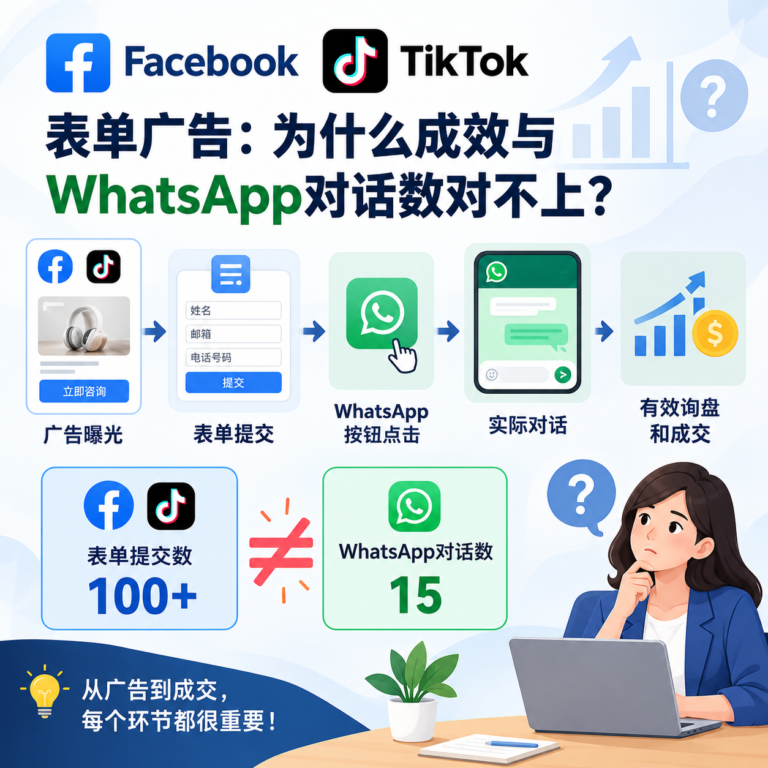
Another model is that after users click on the advertisement, they do not directly complete the website purchase, but enter Messenger, WhatsApp or other communication channels to communicate with sales staff.
A typical path can be summarized as:
Advertising exposure → Click on the message portal → User initiates a conversation → Product consultation → Quotation and confirmation → Payment and fulfillment.
Meta itself offers messaging advertising products for compliant businesses, allowing users to go directly from Facebook or Instagram ads into Messenger, Instagram Direct or WhatsApp conversations. Therefore, diverting advertising traffic to news channels is not a special violation mechanism, but one of the normal forms of commercial customer acquisition.
Relevant instructions can be found in Introduction to message advertising for Meta for Business and Click-to-WhatsApp Advertising Guide for WhatsApp Business。
The characteristic of this type of model is that customers can inquire about price, size, inventory, logistics and payment methods before purchasing. For goods or services that require more communication, dialogue may serve the functions of consultation, screening, and transaction.
But it needs to be noted thatThe number of messages does not equal effective leads, and opening a conversation does not equal the final deal.
If an ad generates a large number of inquiries but not enough actual orders, the cost per message alone may overestimate the effectiveness of the delivery. A more reasonable analysis method is to continue to observe the effective consultation rate, transaction rate after quotation, actual customer acquisition cost, refund and after-sales situation.
For transactions involving counterfeit brands, private messaging will also not eliminate the risks of product infringement, fraud, payment restrictions, or platform policies.
3. What is the difference between the two modes?
| Contrast Dimensions | Independent website transaction | News channel transaction |
|---|---|---|
| User main path | Ads enter the website and make a purchase | Advertising enters the conversation and consults |
| Main conversion steps | Product browsing, additional purchase, checkout, payment | Initiate dialogue, effective consultation, quotation, and transaction |
| key operating capabilities | Website experience, payment, logistics, after-sales | Response speed, sales communication, lead screening, contract fulfillment |
| Common metrics | Additional purchase rate, checkout rate, purchase conversion rate, customer acquisition cost | Effective dialogue rate, consultation conversion rate, transaction cost |
| Main business risks | Website, payment, merchandise and performance risks | Accounts, communication channels, customer trust and performance risks |
| Can product compliance requirements be circumvented? | Can't | Can't |
The core difference between the two models is that the transaction process is different, not that one of them is naturally easier to obtain platform permission. The advertising destination, nature of the goods, advertising content and actual transaction behavior still need to be evaluated separately.
3. Why do some imitation brand advertisements seem to pass the review?
This is an observationFacebook counterfeit adsThis is where misunderstandings are most likely to occur.
Some ads appear to be displayed normally, or even remain for a period of time, which may make people think that the platform does not strictly review them. But outside observation alone cannot determine what review process an ad went through, or whether it was ever rejected, resubmitted, or subsequently disposed of.
To understand this issue, we need to distinguish the following levels.
1. Advertising review does not mean permanent certification of the entire business entity.
Advertising review involves creatives, copywriting, landing pages and other related factors. When an advertisement is approved for placement, it only means that it has obtained the qualification to be displayed in a specific review process. It does not mean that the platform has permanently recognized the source of the product, trademark authorization, supply chain and all transaction behaviors.
After the advertisement is placed, the platform may still re-evaluate the relevant content based on new information, user feedback, rights holder complaints or other risk signals.
Therefore, passing an audit cannot be understood as proof of long-term business compliance.
2. Advertising materials are compliant, but it does not mean that landing pages and products must be compliant.
To determine whether there are risks in the advertising business, you cannot just look at the advertising pictures and text.
For example, the material may not clearly display the brand logo, but the actual goods sold on the landing page may still involve trademark infringement. On the other hand, if the product picture looks like a well-known brand, you cannot conclude that the product is fake based on visual similarity alone; you also need to consider the use of the trademark, authorization status, product source and specific facts.
A more accurate judgment needs to be based on advertising content, actual products and complete transaction links, rather than making conclusions based only on ad previews.
3. Audit results may change over time
The platform's automated review, manual review, user reporting and follow-up investigation may come into play at different stages.
This means that just because an advertisement can still be displayed currently does not mean that it will not be restricted in the future; similarly, if an advertisement is rejected, it cannot be inferred that all products or advertisements of the same type will necessarily be treated the same way.
The duration of advertisements observed externally can only reflect visible phenomena and cannot directly prove the platform’s audit intensity or actual law enforcement probability.
To compare regulatory differences across different advertising channels, relatively reliable and comparable data is needed, such as ad rejection rates, account restriction rates, appeal results, and long-term delivery survival. It’s difficult to draw rigorous conclusions based solely on the number of ads in the feed.
4. What is the Facebook advertising cloak? Why is it controversial?
When discussing counterfeit advertising, the term "cloak" often comes up, often referred to in English as cloaking。
In the context of advertising review, cloaking generally refers to the use of technical means to enable the review system to see different web content than when actual users visit it, thereby masking the real landing page or actual promotion content.
For example, there are substantial differences between the pages seen by the review system and the pages actually visited by ordinary users, resulting in the review process being unable to accurately assess real goods or services.
What needs to be distinguished is that normal website adaptation does not equal a cloak.
The website provides corresponding language versions and page layouts based on the user's language, region, device or screen size, which may be part of normal localization and user experience optimization. The key difference is whether these changes truly and consistently serve user needs, or whether the actual promotion content is deliberately concealed from the review system.
1. Why has cloak become a high-frequency word in industry discussions?
Outside observers may suspect the use of cloaking when certain ads are displayed inconsistently with the page the user ultimately sees.
But it needs to be emphasized thatJust because the ad looks normal and the content changes after being clicked does not mean that the advertiser must have used cloak. Regional restrictions, language settings, website failures, page jumps and other technical factors may also cause different access results.
Determining the presence or absence of a cloak requires further verification of the reason for the page discrepancy and its actual use.
2. What does Meta think of the cloak?
Meta has publicly stated that it views Cloak as a deceptive behavior that may circumvent ad review and hide real website content, and has taken enforcement actions against related advertisements, accounts and services.
In a public statement released in February 2026, Meta again mentioned taking legal action against deceptive advertising and said it was improving the artificial intelligence technology used to identify cloaks. The statement also mentioned that Meta has taken legal action against marketing consultants who promoted the ability to help advertisers circumvent the platform's enforcement mechanisms.
For reference:Meta:Meta Takes Legal Action Against Scam Advertisers。
This shows that cloaking cannot be simply understood as an ordinary advertising optimization technique. It may involve deliberate circumvention of the review mechanism and bring risks to advertising, accounts and related business activities.
From an industry analysis perspective, the focus of discussing cloak should be on understanding its definition, identifying potential risks, and distinguishing between normal website localization and deceptive content, rather than treating censorship avoidance as a sustainable business strategy.
5. Why do some advertisers still choose Meta advertising channels?
If we do not simply attribute the reason to "loose Meta review", we can also understand this phenomenon from the commercial attributes of advertising channels.
1. Social advertising can proactively reach potential consumers
Search advertising is usually closely related to the search needs actively expressed by users, while social advertising can reach potential consumers based on the audience, placement and delivery optimization capabilities provided by the platform.
For products that rely on visual display, pictures, videos and usage scenarios may help users understand the product and further generate clicks or consultation behaviors.
This method of acquiring customers is not limited to the imitation brand industry. Legitimate clothing brands, consumer goods companies and cross-border e-commerce companies will also use social advertising to expand their markets.
2. Website transactions and message transactions can handle different purchasing needs.
Some consumers are more accustomed to browsing the website directly, comparing products and placing orders by themselves; other consumers need to confirm specifications, prices, logistics or other information before purchasing.
Independent stations and message advertisements correspond to different conversion paths and can meet the needs of different business scenarios. However, the specific path to adopt should depend on the nature of the product, customer purchasing habits, service capabilities and actual operating requirements.
3. The optimization capabilities of advertising platforms may improve customer acquisition efficiency
Advertising platforms can optimize ad delivery using information such as targeting, audience signals, and conversion feedback.
However, the optimization effect depends on the business itself. Even if the advertising click cost is low, if the goods cannot be sold in compliance with regulations, the website conversion rate is poor, customers do not trust the payment process, or there are problems with actual performance, the final operating results may still be unsatisfactory.
Therefore, low advertising costs do not mean high profits, and short-term traffic acquisition does not mean that the business is sustainable.
4. Short-term investment performance and long-term operating capabilities are two different things.
Some advertisers may focus more on short-term traffic and immediate orders, but long-term business also needs to consider account stability, supply chain, payment, after-sales, customer repurchase and legal risks.
For businesses involving counterfeit branded goods, short-term advertising effects cannot offset the risks posed by intellectual property infringement and platform policy violations.
This is also a misunderstanding that needs to be avoided when analyzing imitation brand advertising:Think of "being able to get traffic" as directly equivalent to "having a sustainable business model."
6. What are the main risks of counterfeit advertising on Facebook?
The risk of counterfeit brand advertising not only occurs during the advertising review stage, but may also extend to commodity transactions and the entire business chain.
1. Advertising and account risks
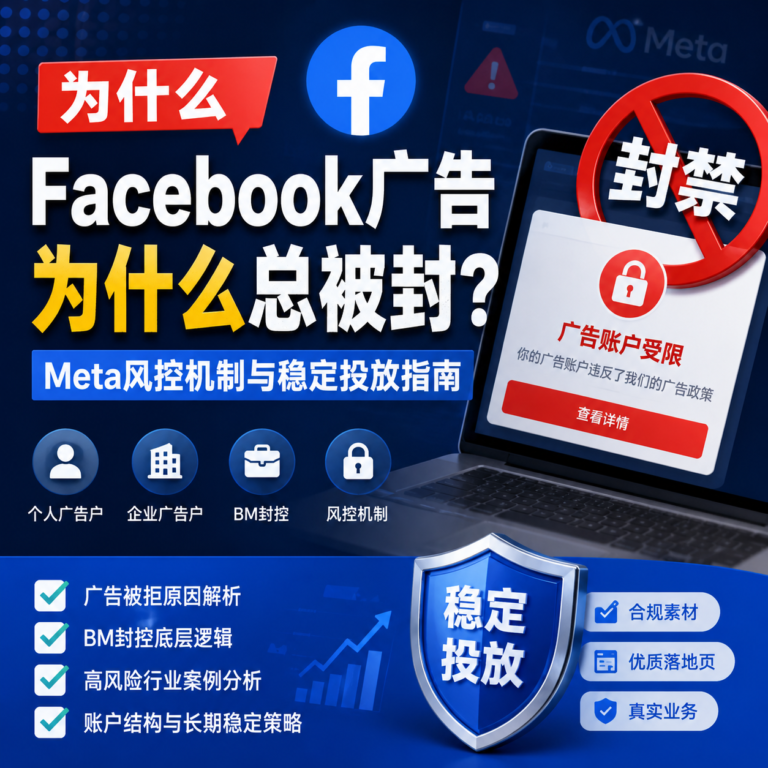
If an advertisement, product or landing page violates platform policies, the relevant advertisement may be rejected, stopped from being displayed or removed, and the account may also be restricted.
Whether an account can be used continuously cannot be judged based solely on past delivery performance. A successful campaign doesn't mean subsequent ads can use the same approach.
2. Intellectual property risks
Unauthorized use of other people's trademarks, logos or other protected intellectual property rights may lead to complaints from the rights holders, platform disposal or legal disputes.
The application of laws and specific responsibilities in different countries and regions need to be judged based on the facts. Calling goods "replicas," "imitations," or other names does not automatically eliminate the risk of trademark infringement.
3. Payment and transaction risks
Payment service providers usually evaluate merchants based on their own rules, business types and transaction risks. Product compliance, chargeback disputes, consumer complaints and other transaction issues may affect the continued use of payment services.
Even if advertising can bring orders, if payment, delivery or after-sales cannot operate stably, advertising investment may not be converted into sustainable operating income.
4. Customer trust and after-sales risks
Online consumers cannot directly inspect products before purchasing, so they often rely on product information, payment processes, logistics commitments and after-sales services to build trust.
If the goods actually received are not as described, the brand source is disputed, or the after-sales communication is not transparent, consumers may request a refund, initiate a dispute or complain.
These problems not only affect a single order, but may also increase long-term customer acquisition and operating costs.
5. Business continuity risk
Business continuity means that a company can acquire customers, process orders, collect payments and complete fulfillment stably over an extended period of time.
If the business relies on accounts that may expire at any time, disputed product sources, or unstable payment links, even if the short-term advertising data is good, it will be difficult to prove that its business model is reliable.
From a business evaluation perspective, what really deserves attention is not whether ads are still displayed today, but whether the business can continue to operate in compliance with platform policies and applicable laws.
7. How to objectively evaluate the actual performance of Facebook ads?
If you want to understand why an advertising business can continue to attract customers, you can't just observe whether the advertisement exists, nor can you just look at a single indicator.
For compliant e-commerce and customer acquisition businesses, we can analyze them from the following dimensions.
| Analysis Dimensions | Issues that require attention | observable indicators |
|---|---|---|
| Traffic quality | Does the ad attract target users? | Click-through rate, landing page visits, effective visit rate |
| website conversion | Does the user have purchase intention? | Add-on rate, checkout rate, purchase conversion rate |
| message conversion | Does the person initiating the conversation have a genuine need? | Effective dialogue rate, lead qualification rate, closing rate |
| customer acquisition cost | How much does it cost to acquire a real customer? | Cost per purchase, effective lead cost |
| operating results | Will profits actually be generated after the transaction is completed? | Net revenue, gross profit, refund rate, actual customer acquisition cost |
| business stability | Can customer acquisition and contract fulfillment be sustained? | Account stability, payment success rate, order fulfillment status |
Here, special distinction needs to be made between advertising platform indicators and actual operating indicators.
For example, a high click-through rate may indicate that the material can attract users, but it cannot alone prove that users have the intention to purchase; a low message cost may indicate that the cost of obtaining dialogue is low, but the quality of the dialogue and the final transaction result still need to be observed.
Similarly, the conversion data displayed in the advertising backend may also be different from actual orders, refunds, and final revenue. Therefore, when conditions permit, the advertising platform data, website analysis data and real order records should be combined for verification.
For businesses involving infringement or evasion of review, the above indicators cannot replace the review of product sources, advertising policies and applicable laws.
8. What is the difference between advertisements of imitation brands and advertisements of legal and affordable substitutes?
discussCounterfeit advertisingWhen doing so, you also need to distinguish between counterfeit branded goods, legitimate affordable substitutes, and similarly styled goods with independent designs.
They may be similar in appearance but are not legally identical.
Counterfeit goods may use someone else's trademark or logo without authorization, leading consumers to mistakenly believe that the goods are from a certain brand. Legitimate, affordable alternatives should not be deemed counterfeit simply because they are lower in price or have a similar design.
Specific infringement needs to be determined based on trademark use, design rights, source of goods, likelihood of consumer confusion and the laws of relevant jurisdictions.
For legitimate merchants who want to expand overseas markets through Facebook or Instagram, more solid business foundations include:
Use goods with legitimate sources and authorized basis;
Ensure that advertising creatives, product descriptions and actual delivered products are consistent;
Avoid using third-party trademarks, brand logos or protected material without permission;
Establish clear pricing, payment, logistics, refunds and after-sales instructions;
Check the platform’s advertising policies and applicable legal requirements in your target market before placing them.
This does not mean that legitimate businesses will not encounter ad rejections or account problems, but that when problems occur, they can be verified and handled based on real product information, authorization documents, and transaction records.
9. Frequently asked questions about counterfeit brand advertising on Facebook
1. Why can I still see counterfeit brand ads on Facebook?
The visibility of an ad does not prove compliance with platform policies. Users only see the display results at a certain point in time, and cannot judge the ad’s previous review, subsequent review, or the actual source of the product. Meta has publicly taken measures to combat counterfeit goods and deceptive advertising.
2. What are the main methods of selling counterfeit brand ads on Facebook?
From the perspective of user paths, common modes include completing browsing and placing orders through independent websites, as well as consulting and completing transactions through messaging channels such as Messenger and WhatsApp. The conversion steps of the two models are different, but neither can eliminate the requirements for product compliance, account policies, and transaction performance.
3. Will Facebook ads still be banned after they are approved?
It's possible. Ad approval does not mean permanent compliance. Subsequent reviews, user reports, rights holder complaints, or other risk information may result in the ad being re-evaluated. Actual disposition depends on the specific content, facts and applicable platform rules.
4. What does Facebook Ad Cape mean?
Cloaking usually refers to using technical means to make the review system and actual users see different website content to conceal the true promotion target or landing page. Normal language adaptation, regional display and responsive layout do not necessarily belong to the cloak. The key lies in whether there is any behavior that deliberately misleads the review system.
5. Does Facebook’s low cost of counterfeit advertising mean high profits?
Doesn't mean. Advertising costs are only a part of operating costs. Effective traffic, actual transactions, payment fees, logistics, refunds, after-sales and other operating expenses also need to be considered. For businesses involving counterfeit goods, platform disposition and intellectual property risks must also be considered.
6. Can I avoid the risk of counterfeit brand advertising by completing transactions through WhatsApp or Messenger?
No. Changing the transaction channel will not automatically change the nature of the goods, nor will it eliminate requirements on advertising content, trademark use, consumer rights and platform policies. Message channels are just a way for users to communicate and conduct transactions.
7. Are there legal affordable alternatives to advertising on Facebook?
Whether it can be placed needs to be judged based on the actual condition of the product, advertising content, relevant intellectual property rights and Meta's advertising policy. A lower price or similar design style does not automatically mean that the product is counterfeit; similarly, the use of descriptions such as "replica" or "replacement" does not mean that the product is necessarily legitimate. Merchants should ensure that the source of the product is clear, the promotion is true, and check the relevant rules.
Conclusion
The reason why Facebook counterfeit advertising continues to be a topic of discussion in the industry involves multiple factors such as consumer demand, the customer acquisition ability of social advertising, the transaction methods of independent websites and news channels, as well as platform review and intellectual property management.
However, observing that some advertisements still exist does not directly lead to the conclusion that Meta has relaxed supervision on imitation brand advertisements; seeing that advertisements can be displayed does not prove that their product sources, business methods or subsequent transactions meet relevant requirements.
The difference between independent website transactions and message transactions mainly lies in how users complete consultation and purchase, rather than which method can naturally circumvent platform rules. The cloak phenomenon reminds us that if there is a deliberate concealment of content between advertising review and real user experience, it may lead to more serious platform and operational risks.
From a long-term business perspective, whether advertising can continue to bring in effective customers, whether transactions can be performed normally, and whether products and business practices comply with applicable rules are more valuable than simply observing whether an advertisement can be displayed.
Therefore, to analyze Facebook counterfeit advertising, we must not only understand the business models existing in the market, but also distinguish between observable industry phenomena and facts that can be verified. Only by putting traffic, transactions, compliance and business continuity in the same framework can we understand this phenomenon more objectively.