Many companies are doingoverseasB2B website buildingSystem selectionEvery time, we will step into a very real pitfall: once we choose the wrong website building system, it will almost be equivalent to "removing it and starting over" in the later stage. Some website building systemsNot suitableGoogle SEO, the website is built but there is no natural traffic; someScalability is too poor, it will be very difficult to connect to CRM, ad tracking, and remarketing later;Weak conversion ability, even the most basic inquiry collection and form tracking cannot be done well, and the advertising budget is wasted.
What's more important is——
Many companies chose the wrong solution in the early stage in order to "save money". As a result, they not only redid their websites but also missed the golden cycle of overseas customer acquisition.
Therefore, this article does not talk empty words, but only helps you solve the three core problems:
👉 Dismantling of the advantages and disadvantages of 5 mainstream B2B website building solutions (real comparison)
👉 How to choose companies at different stages (to avoid detours)
👉 How to build an overseas independent website that can “acquire customers and convert” from the beginning
After reading this, you can basically understand:
Which system should you use, and how to avoid at least 80% of the pitfalls.
Why does the choice of B-end website building system directly affect conversion?
The biggest difference between B2B websites and C-side e-commerce is:
👉 The core is not "ordering", but "inquiry conversion"
a good B2B website building The system must also have:
- SEO capabilities (obtaining long-term traffic)
- Page conversion ability (customer retention)
- Scalability (supports advertising + content growth)
GNADS data comparison (real industry experience)
| System type | SEO capabilities | Page conversion rate | Scalability | average inquiry rate |
|---|---|---|---|---|
| SaaS website building | ⭐⭐ | ⭐⭐ | ⭐ | 0.5%–1% |
| Open source website building | ⭐⭐⭐⭐⭐ | ⭐⭐⭐⭐ | ⭐⭐⭐⭐⭐ | 1.5%–3% |
| Custom development | ⭐⭐⭐⭐ | ⭐⭐⭐⭐⭐ | ⭐⭐⭐⭐ | 2%–4% |
👉 It can be seen:
System selection directly affects the conversion gap by at least 2-3 times
In-depth analysis of 5 mainstream B2B enterprise website building solutions
Option 1: SaaS website building (suitable for novices) Representative: Shopify / Wix / Squarespace
Advantages:
- Quick to get started
- No technology required
- Rich templates
Disadvantages:
- Weak SEO capabilities (uncontrollable structure)
- Not conducive to building complex B2B pages
- Unable to deeply optimize conversions
Suitable for: test projects, starting with a small budget
Option 2: WordPress open source website building (mainstream recommendation)
Advantages:
- Strong SEO (controllable URL, structure, content)
- Rich plug-in ecology (suitable for B2B expansion)
- Low cost and long-term operation
Disadvantages:
- Requires basic technology or service providers
- The initial setup takes a little longer
Suitable for: foreign trade companies, companies doing SEO + advertising for a long time
Option 3: Shopify (e-commerce oriented)
Advantages:
- The conversion link is mature
- Support payment system
- Advertising friendly
Disadvantages:
- Not suitable for B2B complex inquiry logic
- Content SEO capabilities are limited
Suitable for: B2C or light B2B projects
Option 4: Customized development system
Advantages:
- Completely customized to your needs
- The conversion path can be designed in depth
- Can be integrated with CRM system
Disadvantages:
- High cost ($3000–$10000+)
- Later maintenance is complicated
Suitable for: mature enterprises and strong brand owners
Option 5: Domestic website building system (Dreamweaver/Fanke, etc.)
Advantages:
- cheap price
- Good Chinese support
Disadvantages:
- Weak SEO (messy structure)
- Poor overseas access speed
- Not conducive to advertising
Not recommended for overseas B-side website system selection
High contrast decision table (focus on this)
| Plan | Applicable stage | SEO capabilities | transformation ability | budget threshold |
|---|---|---|---|---|
| SaaS website building | Novice test | ⭐⭐ | ⭐⭐ | low |
| WordPress | growth period | ⭐⭐⭐⭐⭐ | ⭐⭐⭐⭐ | in |
| Shopify | E-commerce transformation | ⭐⭐⭐ | ⭐⭐⭐⭐ | in |
| Custom development | Mature enterprise | ⭐⭐⭐⭐ | ⭐⭐⭐⭐⭐ | high |
| Domestic system | Not recommended | ⭐ | ⭐ | low |
B2B website building selection guide (key points)
Step 1: Identify your traffic source first
Mainly SEO → Choose WordPress
Advertising-focused → WordPress + Shopify
Brand official website → Customized development
Step 2: Look at your budget stage
- $500–$1500 → WordPress
- $2000+ → Customization can be considered
- Extremely Low Budget → SaaS Transition
Step 3: Look at business complexity
If you are involved with:
- Multiple product categories
- Multi-country market
- multilingual
Don’t use SaaS
Step 4: Check whether to advertise
If you want to do:
- Google Ads
- Facebook Ads
Must select:
Pages can be optimized
Trackable conversions
Can be quickly revised
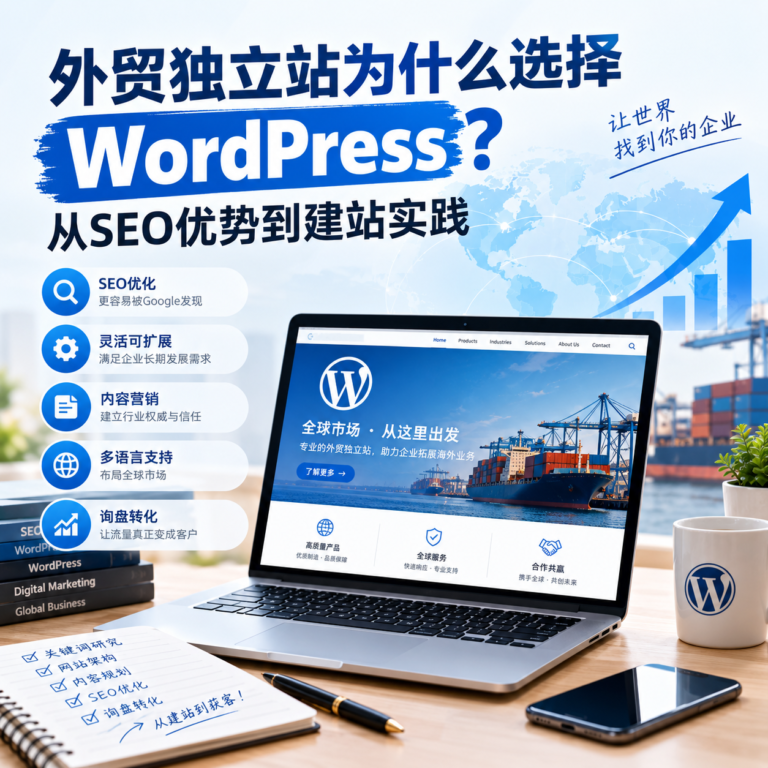
WordPress has the greatest advantage. In fact, we also recommend that B-side users use the WordPress system to build websites. In many industries, the top 10 Google rankings basically have the shadow of the WordPress website building system!
Experts avoid pitfalls (very critical)
⚠️ Warning 1: Don’t just look at “the template looks good”
👉 Good-looking ≠ Ability to transform
Many websites look high-end, but:
- No CTA
- No trust endorsement
- The form is complex
👉 Very low conversion rate
⚠️ Warning 2: Don’t ignore SEO structure
After building a website, many companies find:
👉 No traffic
The reason is:
- URL confusion
- Page not indexable
- Wrong content structure
⚠️ Warning 3: Don’t choose a non-migrating system
If the platform cannot be exported:
👉 It’s equivalent to being locked
The later costs are extremely high.
Summary and action suggestions
If you only remember one sentence:The essence of B2B website building is not to build a website, but to build a conversion system
Optimal choice path:
- Want to do it for a long time → WordPress
- Want to quickly verify → SaaS
- Want to make a brand → Customize
🚀 Practical suggestions:
Newbies can do this:
👉 Prepare a budget of $1000
👉 Build a basic website with WordPress
👉 Launch 10–20 product pages
👉 CooperationGoogle Adstest
Watch after 7 days:
- CTR
- Additional purchase/inquiry
- conversion rate
👉 Zoom in on the direction of good data
Frequently Asked Questions (FAQ)
Q: Is it definitely better to use WordPress for B2B website building?
A: Not necessarily, but in terms of SEO, scalability and long-term operations, WordPress has obvious advantages. Especially companies engaged in foreign trade or advertising are more suitable to use WordPress for B2B website building.
Q: How much does it cost to build a B2B website?
A: Generally speaking, the cost of building a basic B2B website is between $500-$2,000. If it is customized development, it may cost more than $3,000. The key is whether complex functionality and long-term expansion are required.
Q: Suitable for novicesSaaS website building?
A: It can be used as a transitional solution, but it is not recommended for long-term use. Because SaaS has many restrictions on SEO and conversion optimization, it is not suitable for the continued growth of B2B business.
Q: What are the most important indicators for B2B website building?
A: The core indicator isInquiry conversion rate, followed by traffic quality and page dwell time. Many companies only look at traffic but ignore conversions. This is a common misunderstanding.
Q: Is SEO necessary for B2B websites?
A: Strongly recommended. SEO is one of the most stable traffic sources for B2B, which can continuously bring accurate customers and reduce advertising costs.