What does it mean to add a white account on Facebook?
In the Chinese advertising market, "Facebook plus white accounts", "FB whitelist accounts", "overseas plus white accounts" and "overseas three unlimited accounts" are often used together.
Some account opening service providers will claim that this type of account has the following characteristics:
- Advertising review is relatively loose;
- You can put in categories that are difficult for ordinary accounts to pass;
- No restrictions on homepage;
- There is no restriction on promoting domain names;
- It is not easy to trigger consumption limit;
- Accounts can be processed more quickly after being restricted;
- Suitable for finance, stocks, gambling, games and dating ads.
But one key fact needs to be clarified first:
“Facebook add white account" is not a standard advertising account type publicly defined by Meta, nor does it mean obtaining an account that is not subject to advertising policies.
The expression "whitelist" does exist in Meta's public materials, but one of its official usage scenarios is the brand rights protection tool: rights holders can add non-infringing content or accounts to the whitelist to prevent them from continuing to appear in brand infringement matching results. This is not the same thing as having an ad account exempt from review.
The so-called "Added Baihu" in the market is closer to a business name and may refer to:
- Overseas corporate advertising accounts that have completed corporate verification;
- Corporate account created through Meta agent or partner system;
- Accounts that have been authorized to advertise in a restricted industry;
- Advertising accounts with a long normal consumption history;
- An account with a small limit that can be bound to multiple business assets;
- Shared or leased accounts that are packaged as "more relaxed auditing" by the account holder.
These situations are very different and cannot be uniformly understood as "any advertisement can be placed".
What is the difference between "Added White Household", "Overseas Household" and "Three Unrestricted Households"?
| market name | Common meanings | Is it Meta’s official standard account name? |
|---|---|---|
| Facebook add white account | Claims to have received special treatment, agent support, or has higher account permissions | Not a public standard name |
| Overseas business households | Advertising accounts managed by overseas corporate entities or overseas agency channels | "Overseas business households" is the market classification method |
| whitelist accounts | It may refer to an industry authorized account, or it may just be a marketing statement by the service provider. | Need to verify specific authorization |
| 2. No household restrictions | It usually claims that there are no restrictions on domain names, no restrictions on homepages, or no restrictions on consumption. | Not an official Meta classification |
| Three unlimited households | It usually claims that there are no restrictions on domain names, no restrictions on homepages, and no restrictions on consumption. | Not an official Meta classification |
| Industry authorized account | Obtain licenses for specific categories such as gambling, dating, cryptocurrency, etc. | Belongs to verifiable formal authority |
| Agent business account | Corporate advertising accounts created or managed by agencies | Account remains subject to Meta policies |
The third-party account opening market often describes "three overseas restrictions" and "whitelist accounts" as accounts that can launch more categories, switch homepages and domain names, and increase consumption limits. However, these promotions come from account opening service providers and are not Meta's unified commitment to account capabilities.
Therefore, what advertisers really need to verify is not the account name, but:
- Who owns the advertising account?
- who controls the business assets;
- Whether it is really authorized by the industry;
- Which countries does the authorization apply to?
- Which product the authorization applies to;
- Can the homepage, domain name and pixel be managed by the advertiser themselves;
- Who has the right to submit for review after being restricted;
- Whether account funds and historical data can be retained.
What do ZJ, GP, BC and JY mean respectively?
These abbreviations are not Meta's official terms, and the interpretations of different account holders may not be exactly the same.
In some Chinese overseas advertising circles, it is usually understood in the following way:
| abbreviation | Common meanings of investment circles | Policy categories that Meta may involve |
| ZJ | Capital, capital disk or high-risk investment projects | Financial services, deceptive business practices |
| GP | Stocks, recommended stocks, securities or investment services | Financial products and investment services |
| BC | Betting, casino, live entertainment or real money games | Online Gambling and Gaming |
| JY | Friendship, dating or matchmaking services | Dating service |
Third-party account opening advertisements often promote ZJ, GP, BC, and JY alongside financial, gaming, and social products, but there is no unified industry standard for the abbreviations themselves. When judging whether an advertisement can be placed, the real product, company qualifications, landing page and target country should be used as standards, rather than just the abbreviation used by the account holder.
For example, a product also called "GP" might be:
- Brand advertising for licensed securities companies;
- Stock market analysis tools;
- investment education courses;
- Paid stock recommendation group;
- Investment projects that promise fixed returns;
- Fund raising projects without real licenses.
The audit results and legal risks faced by these businesses are completely different.
Why do some people think that adding white accounts overseas is suitable for ZJ, GP, BC and JY advertising?
1. Some accounts have completed industry authorization
Gambling, dating and some financial products cannot be directly launched by simply creating an ordinary advertising account.
Real money gambling ads usually require advertisers to apply for authorization from Meta first and are not allowed to target users under the age of 18.
Advertisements for dating and dating services also require prior written permission from Meta, and can only be targeted to users over 18 years of age after approval.
Some cryptocurrency transactions and related services need to meet the qualifications specified by Meta and may need to complete an authorization application.
Therefore, the real value of some so-called "white accounts" is not that they can bypass the review, but that the corporate entity behind the account has completed a certain formal authorization.
But this authorization is usually:
- Target specific businesses;
- Industry-specific;
- country-specific;
- Target specific domain names or products;
- Subject to valid license and real business.
It's not a universal pass that can be lent to all advertisers.
2. Overseas entities may have licenses required by the target market
Financial, investment, gambling and dating businesses are often regulated by the laws of the target country.
Meta's financial products and services policy states that when placing financial advertisements in some target countries, advertisers may need to hold a license issued by the local regulatory agency.
Meta may also require financial advertisers to verify personal or corporate information before they can continue to publish advertisements for financial products or services.
Therefore, an overseas business account with a local company, license plate, address, website and privacy policy may indeed be easier to verify than an ordinary account with incomplete information.
What comes into play here is:
True corporate identity, compliance qualifications and industry authorization.
Rather than "the account is registered overseas, so the review policy is automatically broadened."
Meta makes it clear that its account integrity and platform rules apply to accounts worldwide. Accounts and business assets that have sustained violations, serious violations, or are used to avoid audits may be restricted.
3. The asset structure of the business account may be more complete
Standardized business accounts are usually managed in a unified manner:
- Business Portfolio;
- Facebook page;
- Instagram account;
- advertising account;
- domain name;
- Pixel or Dataset;
- Conversions API;
- product catalog;
- Payment method;
- Enterprise verification;
- Industry Authorization.
This structure can reduce account issues caused by confusing permissions, inconsistent identities, payment failures, and incorrect data source attribution.
But this can only improve the stability of account management and cannot turn illegal ads into compliant ads.
4. Long-term normal consumption may reduce some operational frictions
Accounts with long-term normal payment records, stable advertising activity, and fewer violations are generally easier to manage than newly created accounts with incomplete information and frequent changes of administrators and payment methods.
However, Meta may still implement:
- Daily spending limit;
- Lower payment threshold;
- Payment function restrictions;
- Advertising account restrictions;
- Business Asset Limitations.
These limits may change based on account risk and activity.
Therefore, "there will be no limit after adding white" should not be regarded as a permanent promise that can be verified.
5. Agents may provide authorization and appeal support
Regular agents may help advertisers:
- Check company materials;
- Check industry qualifications;
- Submit restricted industry authorization;
- Configure Business Portfolio;
- Handle billing and payment issues;
- Understand the reasons for rejection of ads;
- Contact platform support;
- Check advertising and landing page policies.
This support is valuable in high-risk industries, as this type of advertising often involves platform policy, consumer protection and local regulatory requirements at the same time.
However, agency support does not equal policy exemption, nor does it guarantee that every advertisement will pass review.
Why are ZJ and GP ads so risky?
Financial and investment ads may require special categories and verification
Meta's advertising scope for financial products and services includes investment services, insurance, bank accounts, payment services and other businesses.
In applicable regions, advertisers may need to:
- Select special advertising categories for financial products and services;
- Complete business or advertiser verification;
- Submit regulatory license;
- Comply with target country financial advertising rules;
- Use restricted audience settings;
- Provide clear cost, risk and service provider information.
Some financial products cannot be solved through "adding white"
Meta prohibits the promotion of certain financial products and services that are frequently associated with misleading or deceptive marketing.
High-risk expressions include:
- Guaranteed profit;
- fixed returns;
- Zero risk investment;
- inside information;
- Short term doubling;
- You will make money by following orders;
- Stable profits without experience;
- Falsifying celebrity or media endorsements;
- Fake screenshots of account earnings;
- Concealing fees, risks, or withdrawal conditions.
Meta also prohibits the promotion of products, services, and business plans that are deceptive or misleading.
If the so-called ZJ project itself is an unlicensed fund-raising, Ponzi structure, false investment or promised income project, then changing the advertising account cannot change the nature of the product.
Why do BC advertisements often require "authorized accounts"?
BC is often used in betting circles to refer to gambling, casino or real money games.
Meta's treatment of different game types is not exactly the same.
Real Money Gambling and Real Money Games
Promoting online gambling or real money games usually requires prior authorization from Meta and can only be placed on markets where the relevant business is permitted. Advertisements must not be directed to users under the age of 18.
You may need to provide:
- corporate information;
- target country;
- Products and Websites;
- gaming license;
- Regulatory agency information;
- age limit;
- Responsible Gambling Instructions;
- Account and business asset information.
Social casino and free games
Social casino and free games that do not involve real money betting, real money prizes or redeemable value, different licensing rules may apply. But advertisers can’t just modify the copy and package actual real-money gambling into ordinary games. Meta checks ads, apps, landing pages, and actual business models all at the same time.
Overseas accounts do not automatically equal gaming authorization accounts
An overseas corporate advertising account may just be a regular account.
What really needs to be confirmed is:
- Whether the Meta authorization status exists;
- Whether the authorized company is consistent with the advertiser;
- Whether the license covers the target country;
- Whether promoting domain names is an approved business;
- Whether the product is consistent with the application;
- Whether users are restricted to those over 18 years of age.
Why do JY advertisements need a separate license?
JY usually refers to dating, dating or matchmaking services.
Meta currently requires dating advertisers to obtain written permission first, and after approval, they can only serve users over the age of 18.
Even if the advertising account is authorized for dating, the advertising content still needs to avoid:
- Imply that the user has sensitive personal attributes;
- Claims to know a user’s emotional state;
- Use sexually explicit or suggestive content;
- False user information;
- Fake chat messages;
- Misleading "Someone is waiting for you nearby" expression;
- Subscription, renewal or billing methods are not clearly stated;
- Inducing users to submit sensitive private information.
Meta does not allow ads to directly assert or imply the viewer's personal attributes, nor does it allow ads to illegally collect or disclose users' private information.
For example, the following expressions are riskier:
Have you been single and no one likes you?
A more secure expression is:
Discover new interest communities and connect with people who share your interests.
The former directly infers the user's emotional state, while the latter introduces product functions.
What problems cannot be solved by adding a white account on Facebook?
There is no guarantee that the ad will pass the review 100% of the time
Even if an account has been approved for a restricted industry, each ad may still be subject to automated or manual review.
The scope of the review may include:
- advertising copy;
- Pictures and Videos;
- Facebook page;
- Instagram account;
- landing page;
- domain name;
- App store page;
- Payment method;
- corporate identity;
- User complaints;
- Historical violation records.
Unlicensed business cannot be legalized
Account permissions are not a substitute for:
- gaming license;
- Financial regulatory license;
- Securities service qualifications;
- Data protection requirements;
- age limit;
- consumer protection obligations;
- Target country legal permission.
Cannot be used to circumvent review
The following behaviors are high risk:
- The compliance page is displayed during the review, and other pages are redirected after the review;
- Use camouflage or Cloaking;
- Frequently changing domain names to avoid restrictions;
- Use other company licenses to launch your own products;
- using a false business identity;
- Rebuild your account to avoid the original ban;
- Purchase ad accounts that are stolen or of unknown origin;
- Use character substitution to hide offending words;
- Package prohibited business as educational or tool products.
Meta can restrict the creation, modification and associated use of accounts, homepages, Business Manager and advertising accounts in order to evade review or previous penalties.
What are the risks of buying or renting a Facebook account?
1. Advertisers may not have account ownership
Many so-called Baijia accounts are actually controlled by third parties.
Advertisers only have advertising rights, but do not have:
- Administrator rights;
- Business Portfolio ownership;
- billing control;
- Pixel control;
- Domain name control;
- Industry authorization documents;
- Account review permissions.
Once a supplier terminates cooperation, historical audiences, pixel data and advertising structures may not be taken away.
2. Industry authorization may not be transferable
Authorization may be tied to the following items:
- specific enterprise;
- specific license plates;
- specific advertising accounts;
- Specific Business Portfolio;
- specific domain names;
- Specific App;
- Specific target countries.
Just because suppliers can launch their own projects does not mean that they will still be applicable after advertisers change domain names and products.
3. Shared accounts may have associated risks
If an account manages multiple projects from unknown sources at the same time, and one of the projects has serious violations, other homepages, domain names, and advertising assets may also be affected.
Meta can take restrictive measures based on violations of accounts, business assets and associated networks.
4. Funding and billing risks
Leasing or investment accounts may also generate:
- Pre-recharge cannot be refunded;
- Non-transparent exchange rates and service fees;
- The billing entity is inconsistent with the actual advertiser;
- Credit card disputes;
- The account suddenly stops spending;
- Ad balance is frozen;
- Supplier lost contact.
5. Data compliance risks
Financial, dating and gambling projects often collect:
- Name;
- telephone;
- Email;
-Identity information; - financial information;
- payment information;
- age;
- region;
- User behavior data.
Advertisers need to be clear about who collects, stores and processes data, and cannot ignore privacy policies, user consent and data security responsibilities just because they use agency accounts.
How to judge whether a "added account" is authentic and reliable?
Don’t just look at the consumption screenshots sent by the account holder.
You can check according to the following checklist:
| Verification items | Questions that need to be confirmed |
| Account ownership | Whose Business Portfolio does the advertising account belong to? |
| Administrative permissions | Can advertisers gain access to real and independent assets? |
| Industry authorization | Can I see the corresponding authorization status in the background? |
| Authorization object | Does the authorization belong to the account, company, domain name or app? |
| license plate | Is the subject of the license consistent with the advertiser and landing page? |
| target country | Does the authorization cover the actual delivery area? |
| Home page and domain name | Can I use the advertiser's own homepage and domain name? |
| Pixel data | Who owns Pixel, Dataset and CAPI? |
| Account history | Is there a record of serious violations, arrears or grievances? |
| cost | Are account opening fees, rebates, service fees and exchange rates stated in writing? |
| Balance processing | Are the rules for account closure, refund and account transfer written into the contract? |
| Data security | Who has access to customer lists, leads and conversion data? |
If the service provider only emphasizes:
- Never close the account;
- Any product can run;
- No license required;
- Don’t look at the landing page;
- After passing the trial, you can change stations at will;
- Unlimited account changes after being blocked;
- No company information is required;
Such commitments often do not have a credible basis for compliance.
The correct placement path for ZJ, GP, BC, and JY ads
Step 1: Determine whether the business is legal
Confirm:
- Whether the product is allowed to operate in the target country;
- Whether the business requires a local license;
- Whether the license is still valid;
- Whether the website, app and payment method comply with local regulations;
- Are there any features or revenue models that are prohibited from promotion?
Step 2: Determine the Meta policy category
Don't just tell the agent "I want to go to GP".
It should be clearly stated:
- Open an account on a securities platform;
- Invest in education;
- Stock Quote Tools;
- Cryptocurrency trading;
- online casino;
- sports betting;
- social casino;
- dating platform;
- Dating App;
- Offline social activities.
Different authorization processes apply to different businesses.
Step 3: Complete enterprise and industry verification
Prepare according to product:
- Business registration documents;
- Domain name email;
- business address;
- regulatory license;
- App store link;
- Privacy Policy;
- Terms of Service;
- age limit;
-Instructions for refunds and charges; - Responsible gambling page;
- Investment Risk Disclosure.
Step 4: Apply for corresponding authorization
Gambling, dating, some cryptocurrencies and regulated financial products may require separate licensing or verification.
Don’t mistake a certain authorization for use by all sensitive categories.
Step 5: Check the consistency between the advertisement and the landing page
Shown in the ad:
- Company name;
- products;
-price; - Discount;
- risk;
- charge;
- target country;
- License plate information;
It should be consistent with the landing page and actual business.
Step 6: Start with small-scale compliance testing
Verify first:
- Whether the advertisement can be reviewed normally;
- Whether the age of the target user is correct;
- Whether the target country is covered by the license;
- Is the landing page normal?
- Whether Pixel and CAPI are accurate;
- Whether the lead or order is legal and valid;
- Complaints and refunds are unusual.
Passing the review does not mean you can immediately increase your budget significantly. Advertisers still need to continue to observe policy feedback, user complaints and real business quality.
FAQ: Frequently asked questions about adding a white account on Facebook
Is it true that adding a white account on Facebook will not result in account closure?
No account is guaranteed to never be restricted.
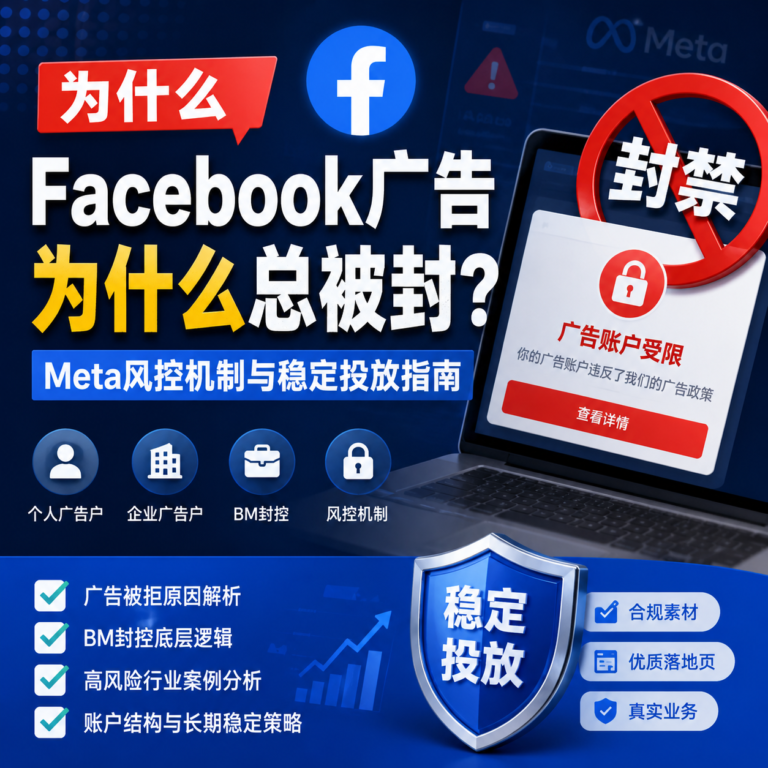
Meta may restrict ad accounts, Pages, Business Portfolios, and associated assets if ads continue to violate policy, promote deceptive businesses, use false identities, or avoid review.
Is the review of overseas accounts necessarily more relaxed than that of domestic accounts?
It cannot be understood this way.
It may be easier for overseas companies to provide target market licenses, local company information and payment information, but Meta’s advertising policy will not automatically expire just because the account is registered overseas.
Can I change the domain name at will when I add a white account?
The so-called "unrestricted domain name" in the market usually means that an account can technically add or place multiple domain names, but it does not mean that any domain name and product will be allowed.
Frequently changing domain names to avoid penalties may trigger account integrity risks.
Can a gambling authorized account place financial or dating ads?
This usually cannot be inferred directly.
Different policies and authorization requirements apply to gambling, dating, cryptocurrency and financial services. Authorization should be based on the background status, license file and specific product.
Can BC ads only target people over 18 years of age?
Not enough.
Real money gambling also usually requires Meta authorization, legal licenses and target region licenses. Being over 18 years old is just one of the basic requirements.
Do I need to apply for permission for JY dating ads?
Needed.
Meta currently requires dating advertisers to obtain written permission in advance and can only serve users over the age of 18.
Can GP stock advertising promise earnings?
There should be no promises of fixed returns, guaranteed profits or zero risk.
Financial advertising also needs to comply with Meta financial products, deceptive business practices and target region regulatory requirements.
Summary: The real value is not “white”, but authorization, qualifications and asset control
Facebook Jiabaihu is a business name in the Chinese account opening and investment agency market. It is not a universal advertising account as publicly defined by Meta.
The reasonable reasons why some overseas business accounts are more suitable for financial, investment, gambling and dating ads are usually:
- The identity of the company is true;
- Possess target country license plates;
- Completed enterprise verification;
- Obtained corresponding industry authorization;
- The account asset structure is complete;
- Payment and consumption records are normal;
- There are agents available to assist with policy and account issues.
They are not exempt from ad review.
For ZJ, GP, BC and JY ads, the core factor that determines whether they can be launched in the long term is not "how white the account is", but:
Whether the product is legal, whether the company is licensed, whether Meta is authorized, whether the advertisement is authentic, whether the landing page is consistent, and whether user data is handled in compliance with regulations.
Understanding adding a white account as a compliance authorized account can help companies reduce operational risks.
If you understand adding a white account as a tool to bypass review, you may lose your advertising account, homepage, domain name, Pixel data and pre-recharge funds at the same time.